Saint
Saint Josephine Bakhita
A Sudanese survivor of slavery who chose religious life and became a witness to freedom, hope, and forgiveness.
A childhood violently interrupted
Josephine Bakhita was born around 1869 in Darfur, in present-day Sudan; she did not know her exact birth date.[1] Abducted as a child, she lost the name her parents had given her amid the terror of captivity.[2] Her captors named her Bakhita, meaning fortunate, a name imposed during an experience that denied her freedom and identity.[2] She was sold repeatedly in the markets of El Obeid and Khartoum and subjected to severe physical and psychological abuse.[2] Remembering these experiences, she spoke of a sustaining strength that had prevented her from surrendering to despair.[3]
The journey to Italy
In Khartoum she entered the household of the Italian consul Callisto Legnani, where she encountered treatment unlike the violence of her previous captivity.[2] When Legnani prepared to leave Sudan, she asked to accompany him to Italy.[2] After arriving in Genoa, she was placed with the Michieli family, eventually caring for their daughter Mimmina at Zianigo, near Venice.[2] When the family’s arrangements took mother and child between Italy and Africa, Bakhita came into contact with the Canossian sisters in Venice.[4] There she entered the catechumenate, the preparation through which she learned about the Christian faith and considered baptism.[4]
Choosing to remain free
When Mrs Michieli returned in 1889 intending to take her back to Africa, Bakhita refused to leave.[4] The account by Aylward Shorter records intervention by the patriarch of Venice and civil representatives affirming that she could not be compelled to return.[4] On 9 January 1890, she received baptism, confirmation, and her first Communion.[1] The names she received were Josephine Margaret Fortunata.[4] Benedict XVI later interpreted her conversion through the discovery of a God who knew and loved her, rather than treating her as something to be owned.[1] Pope Francis likewise distinguished the service forced upon her in slavery from the service she would freely choose in religious life.[3]
Life with the Canossian sisters
Bakhita entered the Canossian novitiate in 1893 and professed her religious vows in December 1896.[4] Her life in the congregation included cooking, sewing, embroidery, and welcoming people at the convent door.[2] She was assigned to Schio in 1902, and during the First World War helped care for wounded soldiers when the convent served as a military hospital.[4] Children attending the sisters’ schools knew her through that daily work of welcome.[2] She also travelled within Italy to support missionary work, sharing the faith that had become central to her own life.[1]
Her testimony and its meaning
In testimony preserved by missionary institutes, Bakhita expressed forgiveness toward the people who had enslaved and mistreated her.[5] She connected that forgiveness with her gratitude to God and her desire that others, including those who had harmed her, should know his love.[5] A prayer associated with her profession remembers her family and expresses the wish that her people in Africa might share her faith.[5] In his interpretation of her life, Francis explicitly distinguished compassion for perpetrators from justification of their injustices.[3] He presented her forgiveness as an expression of recovered dignity and freedom, capable of interrupting the repetition of injury and resentment.[3]
Final years and recognition
Bakhita experienced painful illness in old age and died at the Canossian convent in Schio on 8 February 1947.[2] John Paul II beatified her on 17 May 1992.[4] The same pope canonized her on 1 October 2000.[6] At the ceremony, he linked her witness with suffering in Sudan and appealed for respect for the dignity and rights of women.[6] Benedict XVI made her story a central example in his teaching on Christian hope, emphasizing her conviction that she was loved and that this love could be shared.[1]
A witness against human trafficking
On her commemoration on 8 February 2015, Pope Francis drew attention to the Day of Prayer and Awareness against Human Trafficking organized by religious institutes.[7] He urged action against exploitation and asked people to speak for those whose dignity had been violated.[7] Returning to Bakhita in 2023, he connected remembrance of her life with prayer for peace in Sudan.[3] Her witness therefore carries both a personal and a public meaning: a survivor’s freely chosen life, and a call to recognize the humanity of people whom others reduce to instruments.[3]
Follow the evidence
Sources and notes
- Spe salvi, §3: Josephine Bakhita and Christian hope
Holy See · Benedict XVI · 2007-11-30 · English
Accessed 2026-09-05
- Josephine Bakhita (1869–1947), biography
Holy See · Office for Liturgical Celebrations · 2000-10-01 · English
Accessed 2026-09-05
- Josephine Bakhita: witness of the transforming power of Christ’s forgiveness
Holy See · Francis · 2023-10-11 · English
Accessed 2026-09-05
- Bakhita, Josephine (A)
Dictionary of African Christian Biography · Aylward Shorter, M.Afr. · English
Accessed 2026-09-05
- Goodness and missionary zeal
Holy See · prepared by Pontifical Urbaniana University with missionary institutes · 2001-01-12 · English
Accessed 2026-09-05
- Canonization of Josephine Bakhita and other new saints
Holy See · John Paul II · 2000-10-01 · English
Accessed 2026-09-05
- Angelus: first International Day of Prayer and Awareness against Human Trafficking
Holy See · Francis · 2015-02-08 · English
Accessed 2026-09-05
Editorial notes
The year of birth is approximate. Sources disagree on her age at abduction and the number of sales or captors; the biography does not manufacture a precise chronology from those conflicting figures.
Detailed itinerary and place-name variations in later biographies are not harmonized by guesswork. The narrative uses the common sequence of Sudan, Italy, Venice, and Schio.
Baptism in January 1890, entrance to the novitiate in 1893, and religious profession in December 1896 are separate events. The place of profession is omitted because the consulted accounts are not consistent.
Her statements of forgiveness are testimony about her own religious response. They are not an endorsement of slavery or a demand that survivors excuse their abusers.
No quotation here is presented as a surviving autograph. The missionary witness page is a later collection of reported conversations and a prayer attributed to her.
This expanded biography is an AI-assisted source-based draft. No independent human editorial review or publication approval is recorded.
This is an AI-assisted draft prepared from the sources above. Its citations identify its evidence; they do not replace a historical review.
The inherited biography
The earlier biography for this record, kept unchanged while the sourced draft is reviewed.
Read the inherited biography
Saint Josephine Bakhita, also known as Giuseppina Bakhita, Madre Moretta, and Sister Moretta, was born in 1868 to a wealthy Sudanese family in the region of Darfur, Sudan. Tragically, at the tender age of 9, she was kidnapped by slave-traders and forced into a life of slavery. The captors gave her the name Bakhita, which means "lucky" in Arabic. For several years, Bakhita was sold and resold in the harsh markets of El Obeid and Khartoum. However, in 1883, her life took a significant turn when she was finally purchased by Callisto Legnani, an Italian consul. Legnani had intentions of setting her free, and it was under his care that Bakhita's destiny began to change. In 1885, she accompanied Legnani to Italy, where she started working as a nanny for the Michieli family.
While in Italy, Bakhita was treated with kindness and respect, which was a stark contrast to the cruelty she had experienced as a slave. She quickly grew to love her new country and its people. It was during this time that Bakhita encountered Christianity, and in 1890, she converted to the faith, taking the name Josephine as a symbol of her new life and her deep devotion to Saint Joseph. In 1893, Bakhita entered the Institute of Canossian Daughters of Charity in Venice, Italy, where she dedicated her life to God and the service of others. She took her vows on 8 December 1896 in Verona, Italy, becoming a Canossian Sister for the next fifty years. Bakhita's presence was a source of comfort and solace to the poor and suffering individuals who sought assistance from the Institute.
Her gentle demeanor, warm voice, and willingness to perform any menial task endeared her to those she encountered. In 1930, a biography of her extraordinary life was published, which brought her story to the wider public. Following the publication, Bakhita's reputation as a symbol of hope and resilience spread, and she became a sought-after speaker. She used her platform to raise funds for missions, touching the hearts and inspiring many. On 1 December 1978, Pope John Paul II officially recognized Bakhita's heroic virtues, declaring her venerable. On 17 May 1992, she was beatified by the same pope, acknowledging her as a woman of exceptional holiness. Finally, on 1 October 2000, Bakhita achieved the pinnacle of sainthood when she was canonized by Pope John Paul II at Saint Peter's Basilica in Rome.
Saint Josephine Bakhita is thought to be the only saint originally from Sudan and has become a symbol of strength, resilience, and unwavering faith. Her feast day is celebrated on 8 February, and it has been designated as the International Day of Prayer to Stop Human Trafficking in remembrance of her own experiences and as a call to end modern-day slavery. Saint Josephine Bakhita, the beloved patron of Sudan, passed away on 8 February 1947 in Italy, due to natural causes.
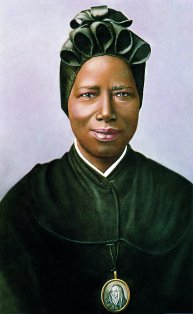
Image: Public domain via Wikimedia Commons (Bakhita Szent Jozefina.jpeg)
Heraldry & Devotional Emblems
Documentary record: no verified arms linked yet. Read the heraldry standard.
Know of a grace or miracle attributed to Saint Josephine Bakhita?
Report a Grace or Miracle