Saint
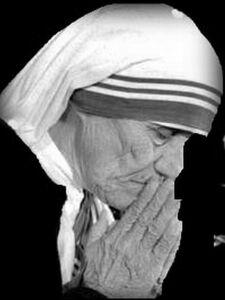
Saint Teresa of Calcutta
A teacher who founded the Missionaries of Charity and brought the needs of abandoned people before the world.
From Skopje to India
Teresa was born Agnes Gonxha Bojaxhiu on 26 August 1910 in Skopje, then part of the Ottoman Empire and now in North Macedonia, to an Albanian family.[1] Her parents were Nikola and Drana Bojaxhiu; the death of her father in 1918 disrupted the household’s security.[2] Her mother’s example and the life of the local Catholic parish helped form her religious vocation.[3] In September 1928 she left for the Loreto sisters in Ireland, then travelled to India, reaching Calcutta on 6 January 1929.[2] Her religious name honoured Thérèse of Lisieux, whose missionary vocation had been lived within a Carmelite monastery.[3]
The years at Loreto
Following her novitiate in Darjeeling, Teresa made first vows in 1931 and taught at St Mary’s Bengali-medium school for girls in Calcutta.[2] She made her final profession in 1937 and became the school’s principal in 1944.[2] Teaching occupied much of her early religious life, while the deprivation she encountered beyond the school increasingly claimed her attention.[1] The Vatican biography remembers these years as a period of commitment to her students and fellow sisters, during which her capacity for organization became evident.[3]
A new call, carefully discerned
Teresa described an experience during a train journey to Darjeeling on 10 September 1946 as a “call within a call.”[2] She understood it as Jesus asking her to establish a community for those in extreme poverty, and submitted that conviction to her spiritual director and archbishop.[2] Church permissions preceded her departure from Loreto in August 1948.[4] After brief training with the Medical Mission Sisters in Patna, she returned to Calcutta, initially staying with the Little Sisters of the Poor.[3] She began visiting sick people, teaching children, and organizing basic assistance; some of her former pupils became her earliest companions.[4]
The Missionaries of Charity
Archbishop Ferdinand Périer established the Missionaries of Charity as a diocesan congregation on 7 October 1950.[4] Their expanding work included Nirmal Hriday, a home for dying and destitute people opened in 1952, a children’s home in 1955, and a mobile leprosy clinic in 1957.[4] The congregation describes the first home as a response to people abandoned on the streets and unable to obtain hospital admission.[5] Its stated aim was to offer the possibility of recovery or a cared-for death to people who otherwise faced either alone.[5] A mission in Ranchi followed in 1959; the first foundation outside India opened in Cocorote, Venezuela, in 1965.[4] The wider movement came to include religious and lay collaborators, with assistance extending to refugees, homeless people, and communities facing disasters.[1]
A worldwide public voice
The Norwegian Nobel Committee awarded Teresa the Peace Prize in 1979, recognizing her response to poverty and the dignity she accorded individual people.[6] The committee highlighted both the Christian source of her convictions and cooperation with people of other religious backgrounds.[6] In her Nobel lecture, Teresa argued that poverty also included loneliness and abandonment within materially comfortable societies.[7] She asked listeners to begin with the people nearest them, paying attention to family members and neighbours whose isolation could otherwise remain unseen.[7] The address also expressed her strong opposition to abortion and promoted adoption and natural family planning, placing her Catholic moral commitments before an international audience.[7]
Faith lived through darkness
Behind her public work, Teresa experienced a prolonged and painful sense of separation from God.[3] The Vatican biography places the beginning of this interior darkness near the start of her new mission and describes it as continuing through her life.[3] Its interpretation connects that experience with her desire to share Christ’s thirst for love and the loneliness of those she served.[3] Her own public account of the congregation’s vocation joined service with contemplation: caring for a person in need was, for her, an encounter with Christ.[7] She measured an action’s religious meaning by the love brought to it, making ordinary, repeated acts of care central to her teaching.[7]
An admired and contested legacy
Her reputation has also been contested: a 2013 review by Serge Larivée, Carole Sénéchal, and Geneviève Chénard raised objections concerning care of the sick, political choices, financial stewardship, and religious positions.[8] The authors questioned the treatment of such criticism in the Church’s assessment of her life.[8] The Missionaries of Charity’s own account emphasizes shelter, personal care, medical assistance, and rehabilitation for people excluded from ordinary support.[5] At her canonization, Pope Francis emphasized her recognition of human dignity and the obligation to serve across differences of language, culture, and religion.[9]
Death and canonization
Teresa died in Calcutta on 5 September 1997 and received an Indian state funeral before burial at the Missionaries of Charity’s Mother House.[2] John Paul II beatified her on 19 October 2003.[2] Pope Francis canonized her on 4 September 2016, presenting her example to volunteers gathered in Rome during the Jubilee of Mercy.[9] He acknowledged that the familiar name Mother Teresa would endure, linking the Church’s formal recognition with the personal way people had come to know her.[9] The congregation she founded continues its work internationally, carrying her vocation beyond the lifetime of its founder.[2]
Follow the evidence
Sources and notes
- Mother Teresa: Biographical
NobelPrize.org · English
Accessed 2026-09-05
- Mother Teresa, Our Foundress
Missionaries of Charity · English
Accessed 2026-09-05
- Mother Teresa of Calcutta (1910–1997), biography
Holy See · Office for Liturgical Celebrations · 2003-10-19 · English
Accessed 2026-09-05
- Our History
Missionaries of Charity · English
Accessed 2026-09-05
- Homes for the Abandoned: the congregation’s account of its work
Missionaries of Charity · English
Accessed 2026-09-05
- The Nobel Peace Prize 1979: press release
Norwegian Nobel Committee · 1979-10-27 · English
Accessed 2026-09-05
- Mother Teresa: Nobel Lecture
NobelPrize.org · 1979-12-11 · English
Accessed 2026-09-05
- Les côtés ténébreux de Mère Teresa (abstract)
SAGE · Studies in Religion/Sciences religieuses · Serge Larivée, Carole Sénéchal and Geneviève Chénard · 2013-01-15 · English
Accessed 2026-09-05
- Canonization of Mother Teresa of Calcutta
Holy See · Francis · 2016-09-04 · English
Accessed 2026-09-05
Editorial notes
The narrative distinguishes Teresa’s reported religious experience from independently observable events, and attributes the theological interpretation of her spiritual darkness.
The Nobel biography’s date for the contemplative sisters conflicts with the Vatican biography. That disputed branch date is not repeated; the congregation’s institutional history supplies the foundation milestones used here.
The Vatican and congregation give different counts of houses at her death. Those figures use potentially different categories and are not presented as a reconciled total.
The 2013 critical review is cited from its publisher’s abstract, captured as web-extracted text because direct HTML access was unavailable. Its criticisms are attributed judgments; this biography does not claim to have adjudicated the allegations or read the paywalled full article.
The Nobel release itself is dated 27 October 1979. The lecture’s attribution of a prayer to Francis of Assisi is not used as evidence of that prayer’s authorship.
This expanded biography is an AI-assisted source-based draft. No independent human editorial review or publication approval is recorded.
This is an AI-assisted draft prepared from the sources above. Its citations identify its evidence; they do not replace a historical review.
The inherited biography
The earlier biography for this record.
Read the inherited biography
Saint Teresa of Calcutta, also known as Mother Teresa, was born Agnes Gonxha Bojaxhiu on August 26, 1910, in Skopje, Albania (now modern Macedonia). She was the daughter of an Albanian businessman who tragically passed away when she was only nine years old.
From a young age, Agnes felt a strong calling to serve God and humanity. In 1928, at the age of 18, she joined the Sisters of Loreto and took the name Sister Mary Teresa. After a period of training, she was sent to India where she became a teacher in Calcutta.
However, in 1948, Sister Teresa felt a renewed and profound calling from God to work directly with the poor and destitute. With permission from her superiors, she left the convent and ventured out alone into the slums of Calcutta. It was there that she encountered extreme poverty, suffering, and a lack of medical care for the most vulnerable members of society.
Driven by her unwavering faith and compassion, Sister Teresa founded the Congregation of the Missionaries of Charity in 1950. The primary mission of this religious order was to care for the "poorest of the poor" and those who had been abandoned by society. The Missionaries of Charity started their work by caring for lepers and providing assistance in disaster-stricken areas.
Saint Teresa strongly believed that every person, regardless of their circumstances, deserved to be treated with dignity and love. She wholeheartedly dedicated her life to this mission, living among the poor and embracing a life of simplicity and self-sacrifice.
Her tireless efforts did not go unnoticed, as she received numerous accolades throughout her lifetime. In 1979, Saint Teresa was awarded the Nobel Peace Prize for her selfless work and unwavering commitment to improving the lives of the marginalized. Prior to that, she received the Pope John XXIII Peace Prize in 1971, and the Jawaharlal Nehru Award for International Understanding in 1972.
Saint Teresa's impact extended far beyond the borders of India. The Missionaries of Charity, under her guidance, expanded their work to 30 countries, providing care to the most vulnerable individuals worldwide.
On September 5, 1997, at the age of 87, Saint Teresa passed away in Calcutta, India, from natural causes.
Saint Teresa of Calcutta was venerated on December 20, 2002, by Pope John Paul II, and beatified on October 19, 2003. Her beatification ceremony took place in Saint Peter's Square, Vatican City, Rome, Italy. The miracle attributed to her beatification involved the healing of an incurable tumor in an Indian woman.
Finally, on September 4, 2016, Pope Francis canonized Saint Teresa of Calcutta, declaring her a saint of the Catholic Church. The canonization ceremony was held in Saint Peter's Square, Vatican City, Rome, and the miracle that led to her canonization involved the healing of brain abscesses in a comatose Brazilian man.
Saint Teresa of Calcutta is widely regarded as an icon of Christian charity and remains a beloved and revered figure. She is the patron of Calcutta, India, as well as the diocese of Calcutta and the Missionaries of Charity.
Heraldry & Devotional Emblems
Documentary record: no verified arms linked yet. Read the heraldry standard.
Know of a grace or miracle attributed to Saint Teresa of Calcutta?
Report a Grace or Miracle